1. Where does San Diego County get its drinking water today?
2. Why is seawater desalination better than importing water or relying on other supplies of water?
3. What impact will desalination have on our long-term water supply?
4. Where will the Carlsbad project be located
5. What is Poseidon's relationship with the Encina Power Station?
6. What communities will the Carlsbad desalination project serve?
7. How will Carlsbad benefit from the project?
8. How will San Diego County benefit from the project?
9. How long will it be until the facility is fully operational?
10. How much will the total project cost?
11. Will city or state tax dollars be used for this project?
12. Will the project cause growth in the region?
13. How much water will the project provide?
14. Will the desalinated water taste different?
15. What state agency will provide oversight to ensure a safe, reliable drinking water supply for San Diego County consumers?
16. Will the facility be an eyesore?
17. If the Encina Power Station were too close, how would the project be affected?
18. Why don't cities and water districts develop their own desalination projects instead of relying on a private company?
19. What are Poseidon's next steps?
1. Q: Where does San Diego County get its drinking water today?
A: A single supplier, the Metropolitan Water District of Southern California, imports up to 90% of the region's water from the Colorado River and Northern California. The rest comes from groundwater, local surface water, recycled water, conservation and other sources.
back to top
2. Q: Why is seawater desalination better than importing water or relying on other supplies of water?
A: The Pacific Ocean represents the ultimate drought-proof resource. A desalination project will provide the City of Carlsbad and other San Diego County water agencies complete control of a local drinking water supply that is not dependent on rainfall or outside suppliers. Diversification and local control are essential to good planning and self-sustainability. That is why the San Diego County Water Authority has declared desalination to be its "preferred alternative" as it looks to diversify its drinking water supplies.
back to top
3. Q: What impact will desalination have on our long-term water supply?
A: When complete, the Carlsbad facility will provide 50 million gallons per day of safe, sustainable, environmentally friendly, drought-proof drinking water without additional cost or risk to ratepayers. It will offset some of the need for imported water and could eventually provide as much as 15% of the region's drinking water, alleviating demand on the traditional sources, and contributing to the regional supply.
back to top
4. Q: Where will the Carlsbad project be located
A:
 |
| Click on image to enlarge |
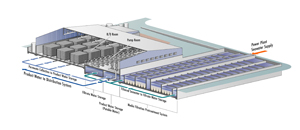
The project will be built in an existing industrially zoned site adjacent to the Encina Power Station on the coast in Carlsbad, California, approximately 35 miles north of San Diego.
back to top
5. Q: What is Poseidon's relationship with the Encina Power Station?
A: Poseidon is an independent company but has entered into a 60-year, renewable lease on the project site with Cabrillo Power 1, the owner and operator of the power station.
back to top
6. Q: What communities will the Carlsbad desalination project serve?
A: The water will flow from the Encina project through a newly constructed pipeline to various locations in Carlsbad. In addition to Carlsbad, Oceanside, Vista, and San Marcos could recieve water from the project.
back to top
7. Q: How will Carlsbad benefit from the project?
A: Carlsbad will receive a certain quantity of high-quality drinking water that is delivered reliably over a 30-year period at a guaranteed price. The City will receive $2 million in property tax from Poseidon once the project is complete. Additionally, the City will gain three key parcels of land near Agua Hedionda Lagoon and Terra Mar Beach.
back to top
8. Q: How will San Diego County benefit from the project?
A: In addition to having a new source of water that is drought-proof, locally controlled and reduces dependence on water imported from Northern California and the Colorado River, the project benefits include 2,100 direct and induced jobs and an economic impact of up to $224 million that construction of the project will provide over a two-year period. When completed, the project will have 18 full-time employees, support 416 direct, indirect and induced jobs, and contribute $37 million in estimated annual spending to the county's economy.
back to top
9. Q: How long will it be until the facility is fully operational?
A: Once permits are obtained, build-out will take two years. The current schedule calls for the facility to be operational in 2008.
back to top
10. Q: How much will the total project cost?
A: The preliminary estimate is approximately $230 million, which Poseidon is responsible for. Installation of the pipeline to connect the facility with the local water supply system will require another $35 million to $40 million.
back to top
11. Q: Will city or state tax dollars be used for this project?
A: No, taxpayers and ratepayers are not at risk. Poseidon will fund the project through the capital markets and will contribute equity to the project. Private investors will assume the majority of the risks associated with the project including permitting, designing, building and operating the facility.
back to top
12. Q: Will the project cause growth in the region?
A: No. Growth in San Diego County and throughout Southern California will occur in accordance with existing and new land use policies. SANDAG has already projected that the county's population will grow by one million by 2030, with most of that occurring from births rather than in-migration. This project will help meet their needs and compensate for the expected cutbacks of supply from Northern California and the Colorado River.
back to top
13. Q: How much water will the project provide?
A: Initial plans call for a 50-million-gallon-a-day (mgd) output - enough for 300,000 people. The facility is modular in nature and capable of being expanded in the future.
back to top
14. Q: Will the desalinated water taste different?
A: More than 1,200 decision-makers and stakeholders have toured the pilot plant and sampled the product. More than 99 percent of respondents rated the desalinated water taste as either Excellent or Good, with 83.9 percent ranking it as Excellent.
back to top
15. Q: What state agency will provide oversight to ensure a safe, reliable drinking water supply for San Diego County consumers?
A: The California Department of Health Services.
back to top
16. Q: Will the facility be an eyesore?
A:
|
|
| Click on image to enlarge |
No. The project will be two-stories high. It will replace an old storage tank that is higher than the proposed structure.
back to top
17. Q: If the Encina Power Station were too close, how would the project be affected?
A: Encina is a "must-run" facility with a long life expectancy. In the unlikely event that the project was to close, Poseidon has acquired the firht to use the power station intake and outfall facilities, to continue full operations for up to 60 years.
back to top
18. Q: Why don't cities and water districts develop their own desalination projects instead of relying on a private company?
A: Because development of major projects is requires significant upfront capital investment and entails significant permitting challenges, a number of municipalities are forming public-private desalination partnerships. The Carlsbad project is being developed, financed and constructed at no expense to the City of Carlsbad, the County Water Authority or any other water supplier. This partnership allows the public entities to access the capital and project expertise brought in by Poseidon without incurring risk. It is the epitome of a win-win solution to a critical need for a reliable, long-term drinking water supply. To read more about successful public partnerships, visit www.usmayors.org/uscm/urbanwater and www.ncppp.org.
back to top
19. Q: What are Poseidon's next steps?
A: Poseidon Resource and the City of Carlsbad have a historic water purchase agreement in place. We are working closely with the City of Carlsbad, multiple state regulators and representatives of local communities and environmental groups to develop detailed plans for approval.
back to top
 |


